Article by Julian Milian, CEO/Founder SMV
The Economics of Starting a Dental Assisting School
A practice-based dental assisting school is not just an education project. With the right structure, it can become a workforce pipeline, a community asset, and a recurring tuition-revenue opportunity for dental practice owners.
Many dentists think starting a dental assisting school requires a major upfront investment, a separate campus, or years of education experience. The practice-based model changes that. Learn how tuition revenue, cohort size, student costs, subscription support, and Clinical Ready™ training can turn an existing dental practice into a local dental assistant training pipeline.
The Economics of Starting a Dental Assisting School Inside Your Practice
Most dental practice owners think about the dental assistant shortage as a hiring problem.
They post job ads.
They interview candidates.
They compete with other practices.
They hire quickly.
They train under pressure.
They hope the new assistant works out.
Then the cycle repeats.
But there is another way to look at the problem.
Instead of only asking, “Where can I find trained dental assistants?” a practice owner can ask a better question:
“What would it look like if my practice helped create trained dental assistants?”
That is the economic shift behind a practice-based dental assisting school.
A dental assisting school inside a practice can do more than educate students. It can support local workforce development, create a student-to-employment pipeline, generate tuition revenue, strengthen the practice’s community presence, and reduce dependence on the outside hiring market.
With the right model, the dental practice is not just reacting to the staffing shortage.
It is building the solution.
Why the economics are different for a dental practice owner
Traditional "brick and mortar" school ownership can feel intimidating.
The owner may imagine a separate facility, large lease obligations, expensive buildout, curriculum development, licensing complexity, instructor materials, student marketing, learning platforms, externship systems, and compliance paperwork.
That is one reason why many dentists never move forward.
The practice-based model is different because the dental practice already has several of the most valuable assets:
A real clinical environment.
Dental operatories.
Equipment.
Supplies.
Clinical leadership.
Community credibility.
A real understanding of what assistants need to know.
A built-in need for trained graduates.
That changes the economics.
Instead of building a school from scratch in a separate academic environment, the dentist can use the existing practice as the foundation for a training program, subject to applicable state rules, facility requirements, approvals, disclosures, and program standards.
The result is a model that can be more practical, more clinically relevant, and more aligned with what dental practices actually need.
The market problem is real
Dental assistant hiring remains a major pressure point for practices. The U.S. Bureau of Labor Statistics projects dental assistant employment to grow 6% from 2024 to 2034, faster than the average for all occupations, with about 52,900 openings per year on average during that period.
The ADA also reported that when dentists were asked in late 2024 about the biggest challenge facing their practices in 2025, staffing shortages were the top response, with about 62% naming staffing shortages as the biggest challenge.
For practice owners, this matters because the staffing shortage is not only about finding people.
It is about finding people who are actually ready to function inside the operatory.
That is where the economic opportunity begins.
The core business model
A dental assisting school inside a practice typically works around a simple structure:
The practice launches a dental assisting training program.
Students enroll and pay tuition.
The practice delivers the program through a structured curriculum, labs, clinical readiness training, and externship pathway.
Students gain hands-on preparation for the dental assisting field.
The practice creates a local training pipeline while keeping student tuition revenue, subject to the program’s actual costs, state rules, and operating model.
In SMV’s subscription model, the dentist is not simply buying documents.
The dentist is accessing a launch ecosystem that can support curriculum, student learning platform, instructor resources, licensure pathway support, Clinical Ready™ training structure, marketing assets, and implementation guidance.
That is important because the economics of a school do not depend only on tuition.
They depend on execution.
A practice needs students.
It needs structure.
It needs state compliant launch steps.
It needs instructor guidance.
It needs a real training standard.
It needs a pathway from enrollment to completion.
It needs a system that helps the owner avoid building everything alone.
What students may pay
Many SMV financial examples use an all-inclusive tuition range of approximately $4,800 to $5,500 per student, depending on the market, program structure, state requirements, and what the school chooses to include.
The school sets its own tuition, subject to applicable state rules, disclosures, refund policies, approvals, market conditions, and program requirements.
In many SMV examples, tuition may be positioned as all-inclusive for students and can include items such as:
Textbooks.
Uniform.
Supplies.
Materials.
CPR certification.
Applicable radiation safety certification pathway, where allowed and applicable.
California infection control and radiation safety certificate pathway, where applicable.
Clinical Ready™ validation, for Premium subscription pathways.
Externship placement support.
That matters because students and parents often want one clear number.
A clean all-inclusive tuition model can make the offer easier to understand and easier to sell.
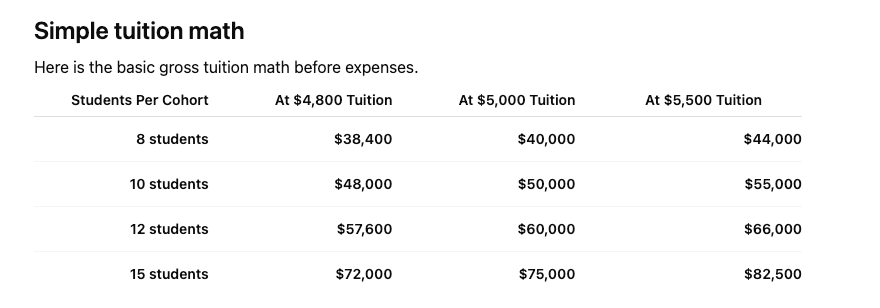
This is why cohort size matters.
A small class can still create meaningful revenue, but the economics become stronger as the program fills seats consistently.
For many practices, a 10- to 12-student cohort is a practical starting point because it is large enough to generate meaningful tuition revenue while still being manageable inside a clinical training environment.
The 12-student example
A 12-student cohort is one of the cleanest examples.
At $5,000 per student, a 12-student class generates:
12 students × $5,000 = $60,000 gross tuition
At $5,500 per student, the same 12-student class generates:
12 students × $5,500 = $66,000 gross tuition
That does not mean the practice keeps every dollar as profit. There are real costs: supplies, materials, student deliverables, instructor time, marketing, administrative work, compliance, state fees, insurance, platform costs, and normal operating overhead.
But the model can still be very attractive.
In many SMV financial examples, after student costs and estimated operating overhead, a school may target approximately $2,600 to $3,100 per student in net contribution, depending on the tuition, market, structure, program costs, and cohort size.
Using that range:
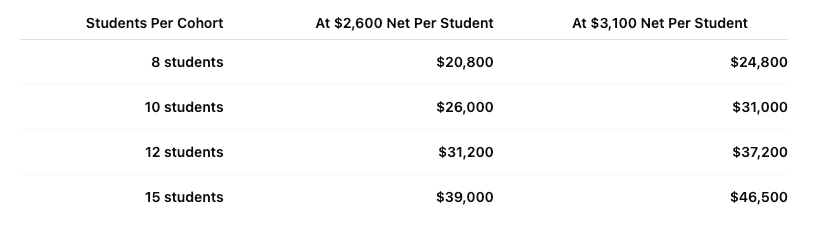
That is why the model is compelling.
A practice does not need hundreds of students to create meaningful economic impact.
A single well-run 10- to 12-student cohort can create a meaningful return while also building a local talent pipeline.
Annualized cohort potential
The next question is not only, “What does one cohort produce?”
The better question is:
“How many cohorts can the practice responsibly and compliantly run per year?”
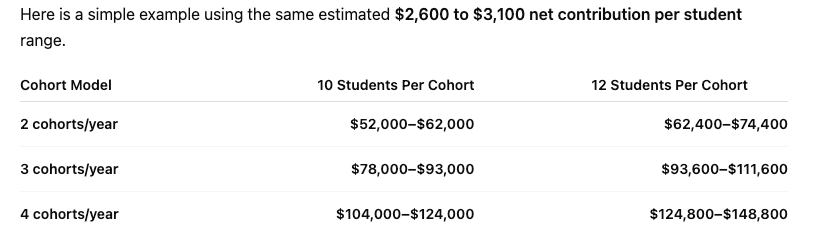
A 12-week dental assisting program can potentially support multiple cohorts per year, depending on state requirements, practice schedule, instructor availability, marketing performance, facility capacity, externship structure, and approval limitations.
That does not mean the school should only enroll two or three students. It simply shows how low the subscription break-even can be before the school begins generating meaningful contribution beyond the subscription cost.
A more conservative way to look at the math is to estimate what the school may clear per student after student costs and operating overhead.
For many SMV examples, a school may clear approximately $2,600 to $3,100 per student after typical student-related costs and overhead assumptions. At that level, each additional enrolled student has real financial impact.
Using that range, a practice may need approximately:
These are illustrative examples, not guarantees.
Actual results depend on tuition, enrollment, state requirements, marketing, refund rules, payment plans, instructor costs, overhead, student completion, and local demand.
But the point is clear:
A practice-based school does not have to become a large college to make financial sense.
It can be a focused local training program with strong economics.
The real value is not only tuition
Tuition revenue is important.
But it is not the only economic benefit.
For a dental practice owner, the bigger value may be the combination of tuition revenue plus workforce pipeline.
A practice-based school can support the owner in several ways.
1. It creates a local talent pipeline
Instead of waiting for the labor market to produce trained assistants, the practice helps train students locally.
That can make recruiting less reactive.
The practice may identify strong students early.
The team can observe work ethic and coachability.
Students become familiar with the clinical environment.
Graduates may be better aligned with real practice expectations.
Even if the practice does not hire every graduate, it becomes part of the local workforce solution.
2. It strengthens the practice’s community presence
A dental assisting school gives the practice a deeper role in the community.
It can attract career changers, high school graduates, parents, local workforce partners, and people looking for a faster path into healthcare.
That can build goodwill and local visibility.
The practice becomes more than a dental office.
It becomes a training hub.
3. It supports staff development
The school can also strengthen the existing team.
Lead assistants may become instructors.
Clinical standards become more defined.
Training becomes more structured.
Current staff can be measured against clearer readiness expectations.
That can improve the internal culture of the practice.
When training standards are clearer for students, they often become clearer for the whole team.
4. It gives the owner a second revenue channel
Dental practices are production-driven businesses.
A school adds a different type of revenue opportunity.
It is still connected to dentistry, but it is not the same as adding another operatory, provider, or procedure type.
For the right practice, the school becomes an education-based revenue channel that uses the owner’s existing clinical environment and expertise.
Why overhead matters
A school owner should not only look at gross tuition.
Gross tuition can be misleading.
The right question is:
After student costs, instructor costs, marketing, administration, compliance, and operating overhead, what does the program actually contribute?
Many SMV financial examples assume approximately 20% operating overhead to run a practice-based school, before certain owner-specific or state-specific costs.
That is only an assumption.
Some programs may operate leaner.
Some may have higher costs.
Some states may require more documentation, fees, space, insurance, approvals, or administrative work.
Some schools may choose to include more student materials or certifications.
Some may spend more on marketing.
A responsible owner should model conservative numbers first.
That is why the ROI calculator matters.
The strongest economics come from knowing the numbers before launching.
Why the subscription model changes the entry point
Historically, many dental practice owners were stopped by high upfront school setup costs. Some as high as $42,000. Not only that, but dentists were then required to give up a per student fee costing upwards of $400 as a sort of royalty.
A dentist might like the idea of launching a dental assisting school but hesitate when the entry cost feels too large or too risky.
The SMV subscription model was built to lower that barrier.
Instead of forcing every dentist into a large upfront implementation fee, the subscription pathway gives qualified practice owners a lower-entry way to access SMV’s launch ecosystem.
That can include support around:
Much higher quality Clinical Ready™ curriculum.
Student learning platform.
Instructor teaching platform.
Instructor certification training.
Instructor resources such as hour-by-hour lab teaching guides.
State licensure pathway and support.
Marketing structure.
Launch workflow.
Implementation support.
Student enrollment assets.
Practice-based training structure.
That matters because the school owner does not need only content.
The owner needs a system.
Curriculum alone does not fill a class.
Curriculum alone does not create compliance readiness.
Curriculum alone does not train instructors.
Curriculum alone does not create student follow-up.
Curriculum alone does not produce Clinical Ready™ graduates.
The subscription model is designed to support the full launch pathway, not just the course materials, at a fraction of the up-front cost required by most vendors.
The break-even question
Every dentist should ask one simple question:
How many students do I need to cover the cost of the subscription and launch support?
The answer depends on the subscription plan, activation fee, monthly cost, tuition, student costs, overhead, and cohort schedule.
But in many examples, the break-even point can be surprisingly low.
For example, if a program clears approximately $2,600 to $3,100 per student, then each additional enrolled student has meaningful impact.
That means the owner does not need a massive class to begin seeing the economics work.
The key is not volume alone.
The key is controlled execution:
Right tuition.
Right market.
Right student marketing.
Right training standard.
Right launch sequence.
Right compliance pathway.
Right cohort size.
Right operational discipline.
That is the difference between starting a school and running a school that makes economic sense.
When it comes to SMV subscription plans specifically:
How many students do I need to cover the cost of the subscription and activation?
The answer depends on the subscription path, activation fee, monthly subscription, tuition, student costs, overhead, cohort schedule, and how well the school executes enrollment.
But with the SMV subscription model, the break-even point can be much lower than most practice owners expect.
Using SMV’s current subscription structure, the annual Year 1 subscription cost is:
That does not mean the school should only enroll two or three students. It simply shows how low the subscription break-even can be before the school begins generating meaningful contribution beyond the subscription cost.
A more conservative way to look at the math is to estimate what the school may clear per student after student costs and operating overhead.
For many SMV examples, a school may clear approximately $2,600 to $3,100 per student after typical student-related costs and overhead assumptions. At that level, each additional enrolled student has real financial impact.
Using that range, a practice may need approximately:
That is the point most dentists miss.
The owner does not need a massive class for the economics to start making sense. A well-run 10-to-12 student cohort can create a meaningful revenue opportunity while also helping the practice build a stronger dental assistant pipeline and very fast ROI.
The key is not volume alone.
The key is controlled execution:
Right tuition.
Right market.
Right student marketing.
Right training standard.
Right launch sequence.
Right state compliance pathway.
Right cohort size.
Right operational discipline.
That is the difference between simply starting a school and running a school that makes economic sense.
A practice-based school should not be built on hope
A dental assisting school can be attractive, but it should not be launched casually.
A practice owner needs to answer important questions:
Is the practice in a state where this model can be pursued?
What approvals, exemptions, registrations, or disclosures may apply?
Is the facility appropriate for training?
Who will teach?
How many students can be trained responsibly?
How will students be recruited?
How will tuition be collected?
What is included in tuition?
How will externship be handled?
How will student readiness be validated?
How will refunds, records, policies, and disclosures be managed?
How will the program protect the practice’s time and reputation?
That is why the right launch system matters.
A school is not just a weekend class.
It is an education operation inside a clinical business.
When built correctly, it can be a powerful asset.
When built casually, it can create unnecessary risk, confusion, and wasted effort.
Why Clinical Ready™ matters to the economics
The economics of a dental assisting school are not only financial.
They are also reputational.
If students graduate unprepared, the school’s reputation suffers.
If externship sites are frustrated, placement becomes harder.
If students do not feel confident, referrals weaken.
If dentists do not trust the graduates, the program loses credibility.
That is why Clinical Ready™ matters.
Clinical Ready™ was built to train around the realities of the dental practice, not just the academic outline of dental assisting.
The focus is on the skills that affect real chairside performance:
Room readiness.
Tray setup.
Instrument anticipation.
Four-handed flow.
Isolation.
Moisture control.
Radiography support.
Turnover.
Infection control.
Material timing.
Documentation.
Error recognition.
Externship readiness.
A school that produces better-prepared students has a stronger chance of building trust in the local market.
That trust can support referrals, enrollment, graduate placement, and long-term program value.
In other words, readiness is not just a student outcome.
Readiness is part of the business model.
The economic shift for dentists
The old mindset is:
“I need to find trained assistants.”
The new mindset is:
“I can help create trained assistants.”
That shift changes the owner’s position.
Instead of being fully dependent on the labor market, the practice becomes part of the local education and workforce solution.
Instead of only spending money to recruit assistants, the practice can build a program that may produce tuition revenue.
Instead of hoping graduates from outside programs are ready, the practice can help train students around the standards real dental offices need.
That is the economic opportunity.
A practice-based dental assisting school can support revenue, staffing, community visibility, and clinical standards at the same time.
Final thought
Starting a dental assisting school inside a dental practice is not just about adding a class.
It is about changing the economics of the staffing problem.
A well-structured program can help a practice owner create a local talent pipeline, generate tuition revenue, strengthen staff standards, and build a deeper role in the community.
The numbers can be compelling.
A 10-student cohort may create an estimated
$26,000 to $31,000 in net contribution.
A 12-student cohort may create an estimated
$31,200 to $37,200 in net contribution.
Multiple cohorts per year can create an even larger annual opportunity.
But the model only works when it is built correctly.
That means the right curriculum, the right launch sequence, the right student marketing, the right compliance pathway, the right instructor support, and the right readiness standard.
That is where SMV comes in.
SMV helps qualified dentists launch practice-based dental assisting schools using a subscription model, Clinical Ready™ curriculum, student and instructor platforms, licensure pathway support, and launch systems built around real dental practice needs.
The staffing problem is not going away.
The better question is whether your practice wants to keep waiting for the market to send trained assistants — or start building them.